

Lead generation in 2026 is no longer about cold emails or guesswork. AI now helps businesses find and convert high-quality leads faster using real data. AI is being employed in businesses to locate, draw, and transform probable consumers more expeditiously and cleverly than ever before.
And, in case you continue to use traditional approaches, you are possibly losing the high-quality leads. The good news? The AI tools have now been simplified, cheaper, and have become exceptionally powerful even to an amateur. A SaaS company increased qualified leads by 60% using AI chatbots and predictive scoring within 90 days.
In this guide, we will simplify all in a way that will enable you to begin using AI to generate leads immediately.
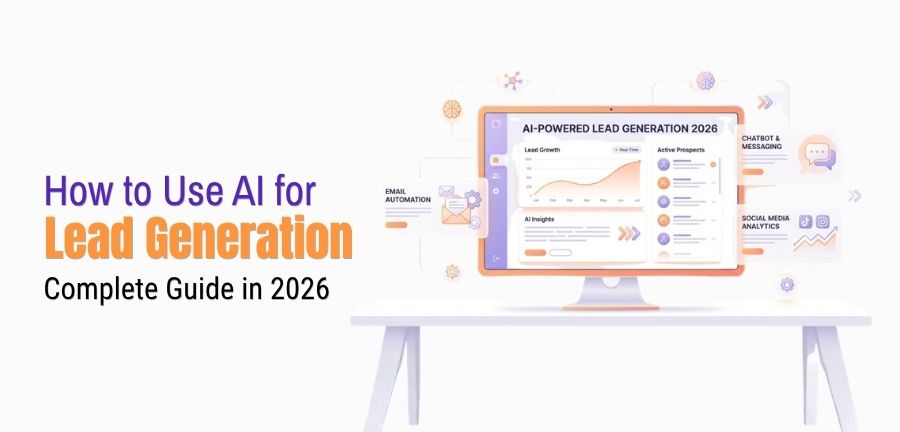
To put it simplistically, rather than having to make guesses or spend time manually trying to reach out to people, AI analyzes the data and intelligent algorithms to discover who your perfect customers are, what they are searching for, and when they are most likely to make a purchase.
The conventional lead generation process is usually time-consuming, which may require cold emails, manual filtering of prospects, and follow-up, one at a time. AI changes that completely. It operates in the background, and it keeps on learning about how you operate and enhances your results with time. The AI systems are able to collect and analyze data related to various sources, such as:
- Website visits
- Social media interactions
- Email engagement
- Search behavior
- Purchase history
Based on this data, AI creates comprehensive profiles of customers and promotes trends that a human could not observe. It then understands these insights to reach the correct audience with the correct message at the correct time.
As an example, a visitor may come to your pricing page several times, then AI will be able to identify the high-intent signal and send a personalized email or chatbot message immediately.
AI helps automate tasks, improve lead quality, and increase conversions through personalization. Business is a fast-changing world. Customers are no longer required to wait days to get a response; they desire them to respond immediately, offer what suits them, and be relevant. It is almost impossible to meet these expectations manually, and that is why AI has become a significant necessity to generate leads in 2026. AI helps businesses:
- Automate repetitive tasks in order to save time.
Some of the tasks, such as sending follow-up emails, updating your CRM, or sorting leads, can require hours. These are automatically taken care of by AI, and your staff can work on important tasks.
- Enhance the quality of leads through intelligent targeting.
Analytics: AI processes the information on your website, social media, and previous customer behavior to identify leads that have the highest likelihood of conversion, so you will not spend time on low-quality leads.
- Personalize to increase conversions.
AI will be able to personalize messages, emails, and offers on individual leads depending on their behavior and interests. Individualized relationships help individuals feel appreciated and thus more ready to act.
- Market without the need to employ huge workforces.
Small or medium businesses will compete with large companies with the help of AI. It enables you to handle additional campaigns, garner additional leads and expand at a quicker rate without having to grow your staff significantly.
Artificial intelligence is developed based on a number of effective technologies that will enable smarter and more efficient lead generation. Given the ability to utilize and learn these tools, businesses will be able to attract a high-quality lead and turn more of them into a conversion without having to allocate additional time or resources.
Machine Learning
Machine learning enables the AI systems to acquire knowledge through information and to get better with time. Through customer behavior patterns, it will be able to determine the prospects that most likely will behave or convert. This implies that your targeting will be more precise in each campaign. In the long run, machine learning will assist businesses to predict trends and optimizing marketing strategies without always being done manually.
NLP Natural Language Processing (NLP).
Natural Language Processing, or NLP, assists AI in responding to and comprehending human language. It is the driving force behind chatbots, email responses, and voice assistants, and enables businesses to engage leads in a more natural, conversational manner. NLP allows customization of the message and making it context-sensitive, which results in a more positive experience of the prospect. The technology will make sure that automated communication remains human and relevant.
Predictive Analytics
Predictive analytics uses historical data to forecast future behavior. By understanding which leads are most likely to convert, businesses can prioritize their efforts on high-value prospects. This reduces wasted time and resources on leads that aren’t ready to buy. Predictive analytics also helps in crafting personalized campaigns that increase engagement and conversions over time.
AI Automation Tools
AI automation tools make it easy to manage and automate your sales processes by taking care of time-consuming and repetitive tasks such as sending follow-up emails and updating CRM systems. This means that you can spend more time working on your strategy and building relationships instead of spending hours on routine tasks. With lead generation now automated with AI, your lead generation will be quicker, more uniform, and dependable.
Machine learning can predict which users are most likely to buy based on past behavior.
The artificial intelligence system provides businesses with multiple effective lead generation and lead development methods for maintaining their competitive edge throughout the year 2026. The implementation of AI tools will enable you to interact with potential customers in a more efficient manner while reducing time expenditures and boosting your conversion rates.
AI Chatbots for Real-Time Lead Capture
AI chatbots enable businesses to capture leads immediately through their website contacts. The system provides instant answers to inquiries while gathering user data and directing customers through the entire sales process. The chatbot system delivers an uninterrupted user experience, which enables businesses to maintain their lead interactions while minimizing the risk of lead loss.
AI-Powered Email Marketing
The process of producing high-quality content on a regular basis presents multiple difficulties. The AI tools generate content that includes blog posts, advertising copy, and social media content, and landing page materials to connect with your target audience. The AI system creates optimized content, which helps businesses attract more clients and maintain customer interest while generating additional sales leads.
Predictive Lead Scoring
AI systems can determine lead value through behavior analysis, which identifies which leads will most likely become customers. The system directs your sales team to work with leads who show the highest potential, which results in better work productivity and more successful customer conversions.
AI in Social Media Lead Generation
Social media platforms contain valuable potential customers, yet organizations face great difficulty when they attempt to run campaigns through manual methods. AI systems use Facebook, LinkedIn, and Instagram user behavior data to discover customers who show strong potential. The system enables you to respond automatically while it improves your advertisement targeting and recommends effective content plans for your social media activities.
AI-Powered Landing Pages
Landing pages function as essential tools for transforming website visitors into potential customers, and AI technology works to enhance their performance through instant optimization. The system uses visitor data, which includes their behavior patterns and their site preferences, to create content and design elements and user interaction points that will generate maximum conversions. Personalized landing pages make each visitor feel understood, which increases the chances they will take the next step.
The upcoming year 2026 will introduce artificial intelligence systems that enable businesses to produce sales leads at an accelerated pace with increased intelligence and improved operational effectiveness. The appropriate tools enable your team to achieve their objectives through efficient work practices which enhance their productivity. The following list presents some of the best AI platforms which you should evaluate for your needs.
1. Apollo.io
Apollo.io functions as a complete system which handles both prospecting and outreach functions. The system employs artificial intelligence technology to assist users in finding high-value prospects while it provides lead automation capabilities and generates customized communication templates. The system enables sales teams to work more efficiently because it provides direct connections with Salesforce and HubSpot and other major customer relationship management systems.
2. Clay
Clay operates as a data enrichment tool while it provides users with prospecting capabilities. The system uses AI research together with automated processes to enable users to find leads and create messages while it allows them to gather information from hundreds of different data sources to enhance their database. Clay software provides teams with a solution that enables them to keep their contact data current and practical for their operations.
3. 6sense
6sense functions as a platform that analyzes customer behavior through predictive modeling and intent recognition technologies. The system applies artificial intelligence to detect potential customers who display purchasing intent while it ranks those customers according to their suitability for sales contact.
4. Instantly
The software Instantly provides businesses with tools to send large volumes of emails. The platform uses AI technology to perform three tasks which help users reach more customers through their email campaigns without needing to do extra work. The platform works best for teams who need to send large amounts of emails while specifically targeting particular audiences.
5. Landbot
The Landbot platform enables websites and WhatsApp to use AI technology for chat and lead qualification. The system uses natural language AI assistants to interact with visitors. The system allows automated lead routing to designated team members while it collects visitor information.
6. HubSpot Sales Hub
HubSpot Sales Hub combines CRM and AI-powered sales tools in one platform. The AI assistants of the system support three marketing activities which enable teams to automate their work through common tasks while they maintain customer contact.
7. Intercom
The Intercom chat platform uses AI technology to handle lead qualification and support functions at high volumes. The system offers complete automation for responses and answers common questions while directing high-value leads to your sales team for follow-up.
8. Qualified
The qualified platform enables B2B organizations to use website live chat for account-based marketing. The AI-driven chat system provides automated prospect qualification while directing them to the appropriate sales representatives. The system helps organizations convert more high-value leads into customers.
9. Unbounce
Unbounce is an AI-powered landing page platform. The system tests different page elements in real time to achieve better conversion results through its layout and copy, and call-to-action testing. The system allows marketers to create landing pages that change according to how visitors interact with the page without needing them to make manual changes.
10. Typeform
Typeform makes it easy for users to create forms that help them collect leads in an interactive way. The AI-powered system helps organizations evaluate leads while it recommends tailored follow-up actions to create a website experience that leads to high conversion rates.
The process of generating leads has become faster and more intelligent through the implementation of AI technology. The guide demonstrates AI capabilities that enable businesses to identify and acquire leads while building lead relationships through efficient lead management and operational time savings.
Step 1: Define Your Target Audience
People need to identify their target audience before they start using AI tools because this information serves as the base for all AI work. Business needs require the process of creating an ideal customer profile which includes customers needs and problems and their online activities. The understanding of your audience enables AI tools to function more effectively which creates better results to attract genuine leads who want to buy your products or services instead of receiving random contact information.
Use Google Analytics + CRM data to define your ideal customer profile.
Step 2: Choose the Right AI Tools
The market offers numerous AI tools which users can choose from but they should begin their work with only one selected tool. The initial step requires you to choose your platforms based on the targeted objectives which include prospecting, email automation, chat engagement and predictive lead scoring. Your team should start with one or two tools which they will learn to use before they gradually add more tools to their collection.
Step 3: Automate Lead Capture
Your lead capture system needs you to start automated lead collection work after you finish setting up your tools. The system uses AI chatbots and forms together with landing pages to gather data from visitors through their website activity and social media interactions and campaign efforts. The system uses automation to protect all leads while providing instant feedback which organizations require to operate effectively in the current quick moving digital environment.
Step 4: Implement Lead Scoring
Not all leads are created equal, and AI can help prioritize them. The system uses predictive lead scoring to evaluate prospects through their engagement with our content and their actual behavior and their expressed intent. The system enables your sales team to concentrate on leads with high conversion potential which results in better performance and higher conversion success rates.
Step 5: Nurture Leads with AI
The process to acquire a lead requires two steps which begin after the initial lead acquisition. The system uses AI to lead potential customers through personalized email sequences which include content recommendations and well-timed follow-ups. The AI system enables you to deliver precise messages to customers at specific moments which builds trust while helping them proceed through their purchasing process.
Step 6: Analyze and Optimize
You need to track your results while using AI insights to develop your strategies. The system tracks which campaigns achieve optimal performance while identifying points where leads abandon the process and which techniques result in successful conversions. The ongoing process of analysis and optimization will help your lead generation activities evolve which will enable you to maximize your return on AI expenditures.
Artificial intelligence improves the speed, intelligence, and efficiency of lead generation processes. The system assists companies in identifying premium leads while creating personalized connections and handling their standard operations through automated processes. Artificial intelligence usage enables you to attain time savings and superior outcomes while building your sales pipeline at an optimal pace. Businesses using AI see up to 30–50% increase in lead conversion rates.
1. Faster Lead Identification
Artificial intelligence technology enables rapid processing of extensive data sets to detect potential customers. The method enables faster discovery of valuable leads because it operates more quickly than manual research methods. The method enables businesses to begin their prospecting process at an earlier time which results in increased productivity during their outreach efforts.
2. Improved Lead Quality
Artificial intelligence utilizes behavioral data and intent data and engagement data to assist you in identifying leads who have the highest potential for conversion. Your sales team will dedicate their time to pursuing valuable prospects while they avoid engaging with contacts who show minimal potential.
3. Personalized Customer Experiences
Artificial intelligence technology generates customized email content, message content, and content assets based on user behavior and their personal preferences. When leads receive customized interactions, they perceive their worth to the company, which boosts their chances of both engagement and conversion.
4. Time and Cost Savings
The process of automating repetitive work, which includes follow-up tasks and data entry procedures, and lead scoring activities, establishes time efficiency and decreases operational costs. The automated system enables your team to concentrate primarily on strategic tasks and deal-closing activities instead of performing repetitive manual tasks.
5. Better Campaign Performance
The artificial intelligence system conducts ongoing examination of marketing campaigns to determine which elements function effectively and which components fail. The gathered insights enable you to enhance your marketing strategy, which results in better audience engagement and greater precision in targeting, and more effective customer conversion.
6. Scalable Lead Generation
Artificial intelligence technology enables organizations to expand their lead generation activities without requiring additional staff members. Businesses can efficiently expand their lead generation operations through campaign management and prospect outreach, which helps them build a larger sales pipeline.
AI brings various advantages to businesses, but it creates multiple difficulties. Businesses need to understand their limitations to use it properly, while they must learn to prevent common errors.
1. Data Quality Issues
AI depends on its data because only accurate data enables it to function properly. Inaccurate or incomplete data leads to poor lead scoring, irrelevant targeting, and wasted effort on low-quality leads.
2. Over-Automation
Excessive dependence on AI systems creates a robotic atmosphere between users and AI systems. Organizations need to use technology solutions together with human expertise because this combination builds trust and develops employee relationships.
3. Complexity of Implementation
Some AI tools need people with technical knowledge because they require setup, integration, and training. If organizations do not create adoption procedures through careful planning, then they face the risk of encountering implementation delays.
4. Cost Considerations
Small businesses face high costs when they try to acquire advanced AI platforms. Organizations need to assess their investment needs against their expected ROI to prevent excess spending.
5. Dependence on Technology
AI systems lack the ability to fully replicate human decision-making abilities. Businesses that excessively depend on AI technology miss important chances that demand personal understanding and artistic thinking.
Combine AI automation with a human strategy to avoid over-automation.
AI in lead generation is evolving faster than ever, and the coming years will bring even smarter, more intuitive tools. Businesses can expect hyper-personalized customer journeys, where AI predicts exactly what a lead wants and when they want it. Conversational AI, voice interactions, and smarter predictive analytics will make engagement feel more natural and real-time. AI will soon predict customer intent before they even search, using behavioral data.
Automation will become more seamless, integrating across marketing, sales, and customer support, while AI-driven insights will allow teams to anticipate customer needs before they even arise. Companies that adopt these advanced AI trends early will have a major advantage, turning data into actionable leads and staying ahead of the competition.
To get the most out of AI for lead generation, it’s important to use it strategically rather than relying on it blindly. Start by combining AI tools with human insight. Automation works best when paired with a thoughtful strategy. Focus on collecting high-quality data, as clean, accurate information is the foundation for AI to deliver meaningful results.
Always personalize your messaging, even when using AI, to keep interactions relevant and human. Test and optimize campaigns regularly using AI insights to see what works and what doesn’t. Finally, respect privacy and follow data regulations to build trust with your leads and maintain long-term credibility.
AI is changing the way businesses find and connect with leads. It makes lead generation faster, smarter, and more effective, helping you reach the right prospects at the right time.
For small business owners and marketing teams alike, AI can save time, improve lead quality, and grow your pipeline more efficiently. The key is to start small, experiment with tools, and keep refining your approach. The sooner you embrace AI, the more your business will benefit from smarter, data-driven lead generation.
Is AI lead generation suitable for small businesses?
Yes, absolutely. Many AI tools are affordable and easy to use, making them perfect for small businesses looking to grow.

Which AI tool is best for beginners?
Beginner-friendly tools include chatbot builders and email automation platforms. Look for tools with simple dashboards and tutorials.
Can AI replace human sales teams?
No, AI supports sales teams but doesn’t replace them. Human interaction is still essential for building trust and closing deals.
How much does AI lead generation cost?
Costs vary depending on the tools you use. Some platforms offer free plans, while advanced tools may require monthly subscriptions.
How does AI improve lead quality?
AI analyzes user behavior and data to identify high-intent leads, ensuring you focus on people who are more likely to convert.
What industries benefit most from AI lead generation?
Almost every industry can benefit, including e-commerce, real estate, SaaS, healthcare, and finance.